
Speculative agriculture
Three rotating terrarium models that give every crop exactly the light it needs — inspired by the Pyramids of Babylon, the globe, and a popsicle
Speculative design · Goldsmiths · 2022Every crop has a specific sunlight requirement — the angle, duration, and intensity it needs to grow well. Most allotment or indoor farming setups ignore this entirely, placing plants in fixed positions and hoping for the best. This project proposed a different approach: what if the planter itself rotated to track and optimise light exposure for each crop, independently and simultaneously?
The result is a series of three speculative terrarium plantation models — each a scaled-down physical prototype of a concept that could work at allotment scale. Each model solves the light problem differently, drawing on a completely different historical or everyday inspiration.

3 rotating layers on a central axel. Inspired by the Pyramids of Babylon.
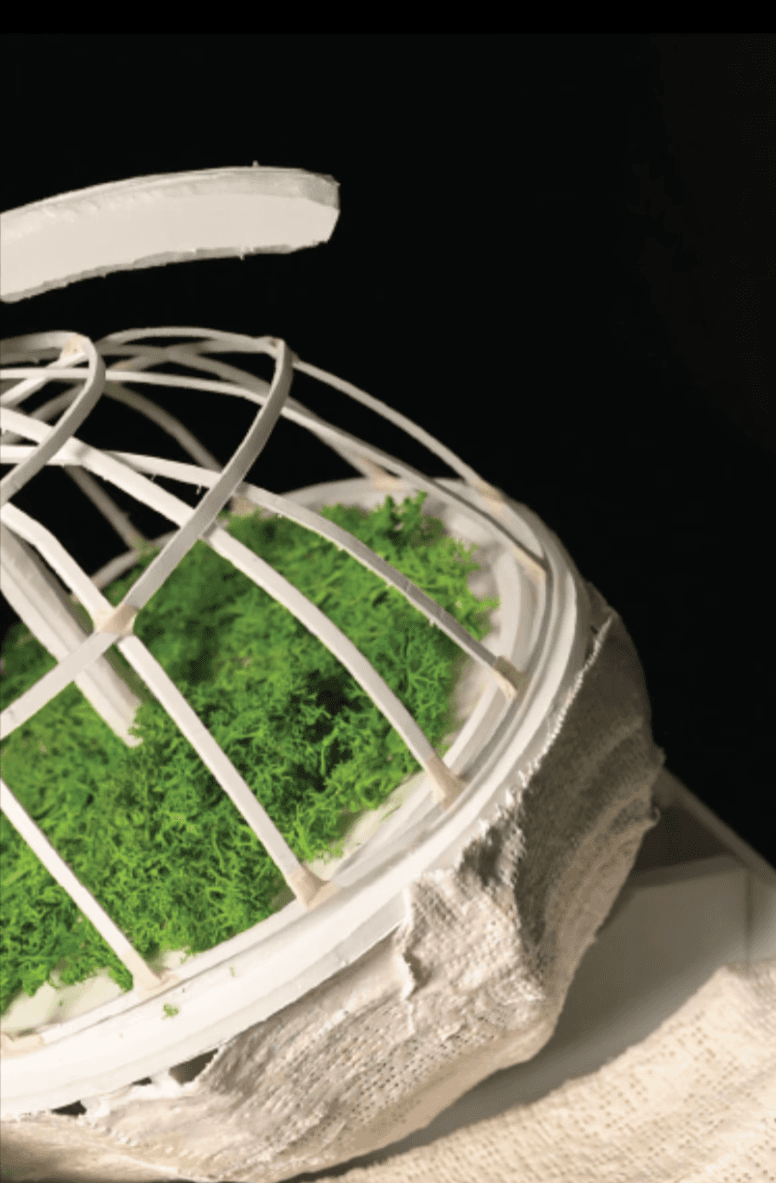
Rotates at a customisable angle matching crop sunlight requirements. Inspired by the globe.

Hydroponic vertical farming. Inspired by a popsicle, drawers, and layered structures.
All three models were physically prototyped at scale. The Pyramid's independent layer rotation worked as designed — rotating layers separately allowed noticeably different light angles to be achieved simultaneously within the same structure. The Globe's adjustable tilt proved the simplest mechanism of the three and the most immediately intuitive to use. The Plant Popsicle's drawer system demonstrated the strongest space efficiency.
The series as a whole is speculative rather than production-ready — its value is in demonstrating that the light-optimisation problem in small-scale agriculture is solvable through mechanical means, without electronics, sensors, or automation. The next step would be testing at actual allotment scale with real crops over a growing season.